


Learn more about GRAST
Sumitomo Rubber's Seismic Dampers Effective Against Long-Period Ground Motions

Our seismic dampers provide effective control over long-period earthquake motions, including the micro-vibrations that occur within that spectrum.
Sumitomo Rubber's seismic dampers exhibit minimal frequency dependence, enabling them to suppress micro-vibrations generated by distant earthquakes. This makes them highly effective for mitigating long-period earthquake motions in high-rise buildings.

Key features of Sumitomo Rubber's seismic dampers
- Absorb energy from small deformations, effectively reducing wind-induced vibrations.
- Achieve a compact design by increasing the hardness of the high-damping rubber material.
- Allow optimal damper capacity adjustment through combinations of identical units and shape modifications of the units themselves, enabling tailored operation according to building scale.
- Exhibit minimal temperature dependence and aging effects, ensuring stable performance over time.
- Feature a simple structure composed only of high-damping rubber and steel flanges, minimizing looseness at the mounting points.
What is a long-period earthquake? :
A long-period earthquake is characterized by slow shaking that lasts for an extended period of time.
There is growing concern about damage to high-rise buildings located far from the earthquake’s epicenter.
Long-period earthquakes produce slow vibrations that can continue for several minutes to around ten minutes. Since these vibrations attenuate slowly, strong shaking can be observed even hundreds of kilometers away from the epicenter.

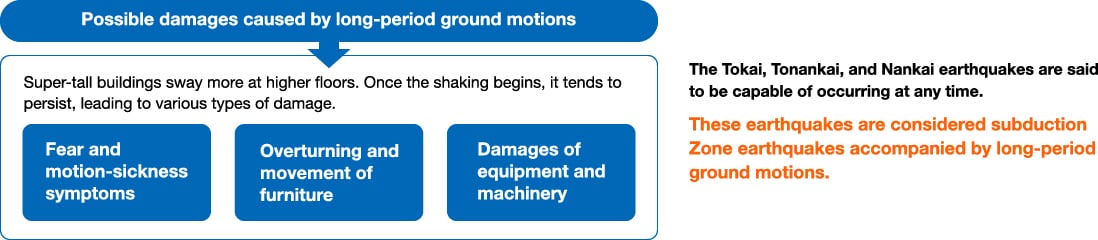
Buildings must be designed to account for long-period seismic motions. In particular, it has become standard practice in the design of super high-rise buildings to consider long-duration, repeated shaking. By adopting vibration control devices with excellent fatigue resistance, structures can effectively respond to such motions.
Government Initiatives: The Ministry of Land, Infrastructure, Transport and Tourism (MLIT) advances measures for long-period earthquake mitigation
Long-period shaking is now required to be considered in seismic design. Until now, the Building Standards Act calculated seismic resistance assuming short-period earthquakes, such as the southern Hyogo prefecture earthquake.
From now on, structural calculations for new super high-rise buildings, which may experience strong long-period shaking from distant epicenters, will be mandatory, further strengthening earthquake resistance.
Reference sites
Public Consultation on Draft Measures for Long-Period Seismic Motions in Super High-Rise Buildings (Ministry of Land, Infrastructure, Transport and Tourism)
Long-Period Shaking Countermeasures for Super High-Rise Buildings to Become Mandatory — MLIT Policy (Asahi.com)